

Non-Alcoholic Beer Market Anticipated to Grow from USD 21.35Billion in 2025 to USD 43.72B by 2035 due to wellness demand
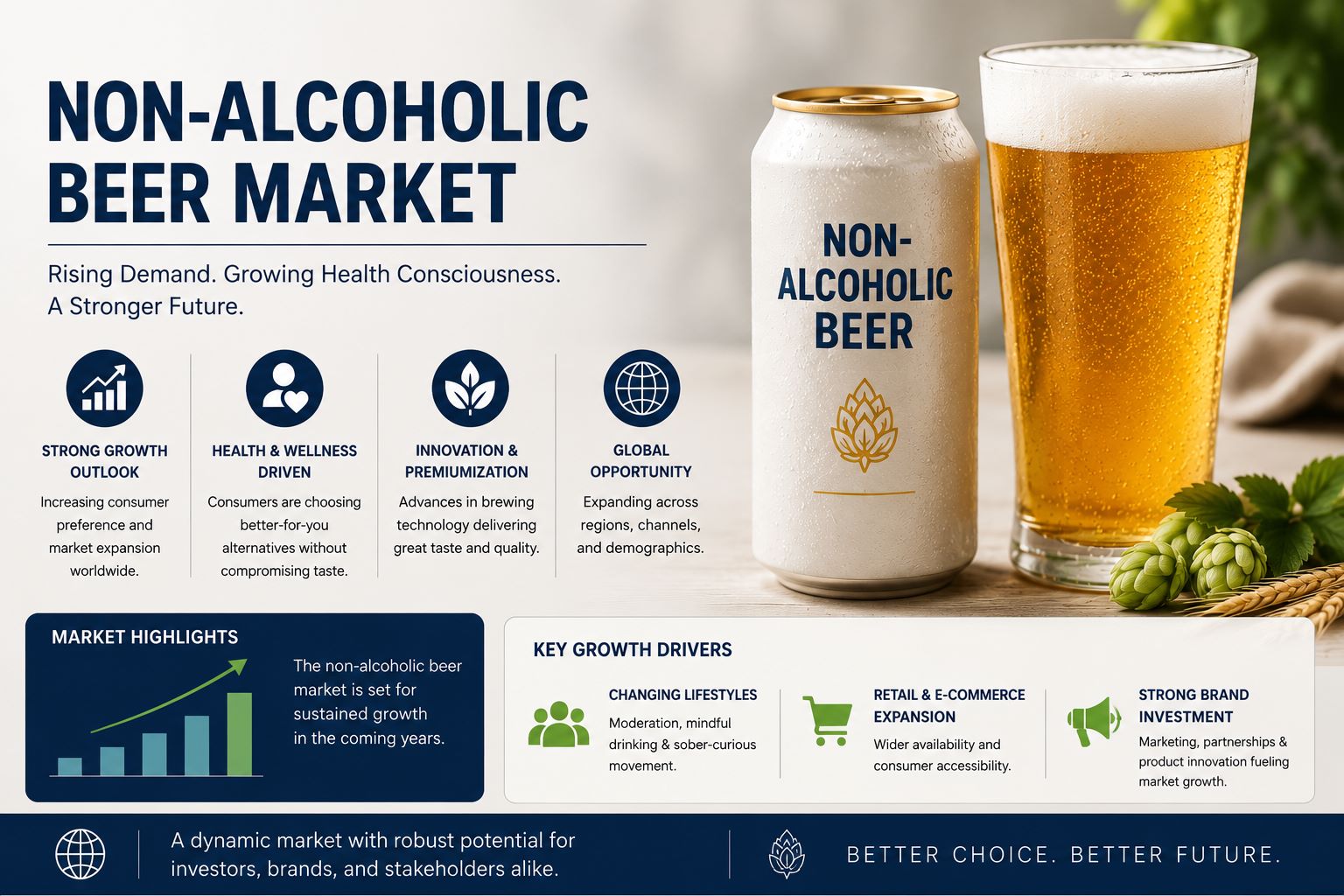
Non Alcoholic Beer Market
Non-Alcoholic Beer Market is segmented by product type, distribution channel, packaging, flavor profile, and region.
NEW YORK, NY, UNITED STATES, June 22, 2026 /EINPresswire.com/ -- The global Non-Alcoholic Beer Market is witnessing a strong transformation as shifting consumer lifestyles, increasing health awareness, and innovation in beverage formulation reshape the alcoholic beverage industry. Valued at USD 19.87 billion in 2024, the market is projected to reach USD 21.35 billion in 2025 and is expected to grow significantly to USD 43.72 billion by 2035, expanding at a compound annual growth rate (CAGR) of 7.43% during the forecast period 2025–2035.This rapid growth reflects a broader global movement toward mindful drinking, where consumers are actively reducing alcohol consumption while still seeking flavorful, social, and premium beverage experiences. Non-alcoholic beer has emerged as a key category addressing this shift, offering the taste and experience of traditional beer without the intoxicating effects of alcohol.
Market Overview:
The non-alcoholic beer industry has evolved from being a niche segment into a mainstream beverage category. Earlier perceived as a substitute for individuals avoiding alcohol due to health or religious reasons, it is now increasingly consumed by a broader audience seeking healthier lifestyle choices. This includes fitness-conscious individuals, professionals, and younger consumers who prioritize wellness without compromising on social drinking culture.
Manufacturers have significantly improved brewing techniques, enabling the production of non-alcoholic beers that closely replicate the flavor, aroma, and mouthfeel of traditional beer. Advanced dealcoholization processes and fermentation control technologies have played a critical role in enhancing product quality and consumer acceptance.
Additionally, changing social norms around alcohol consumption, particularly among millennials and Gen Z, have contributed to the rapid adoption of alcohol-free alternatives. These consumers are more open to experimenting with functional beverages that align with their health and lifestyle goals.
Download Free Sample PDF Copy : – Access A Complimentary Copy of Our Report to Explore Its Content and Insights
https://www.marketresearchfuture.com/sample_request/3912
Market Growth Outlook:
The market’s expansion from 2024 to 2035 indicates sustained long-term demand. The industry is expected to more than double in value, reflecting strong consumer acceptance and continuous product innovation.
Between 2025 and 2035, steady growth will be supported by increasing urbanization, rising disposable income, and expanding distribution networks. Supermarkets, convenience stores, online platforms, and hospitality channels are all playing a crucial role in improving product accessibility.
Furthermore, seasonal demand fluctuations are becoming less pronounced as non-alcoholic beer transitions from a substitute product to a lifestyle beverage consumed year-round.
Key Growth Drivers:
A major factor driving market expansion is the global shift toward healthier lifestyles. Consumers are becoming more conscious of the negative health effects associated with excessive alcohol consumption, including liver disease, weight gain, and sleep disruption. As a result, many are actively seeking alternatives that allow social participation without alcohol intake.
Another key driver is product innovation. Beverage manufacturers are investing heavily in research and development to enhance flavor profiles and diversify product offerings. New variants such as craft-style non-alcoholic beers, flavored beers, and low-calorie formulations are attracting a wider consumer base.
The rise of fitness culture is also influencing demand. Health-conscious individuals, including gym-goers and athletes, are increasingly choosing non-alcoholic beer as a post-workout or social beverage option, aligning with their nutritional and wellness goals.
Competitive Landscape and Key Companies:
The global Non-Alcoholic Beer Market is highly competitive, with major beverage companies and craft breweries actively expanding their portfolios. Leading players include:
▪️Heineken (Netherlands)
▪️Anheuser-Busch InBev (Belgium)
▪️Carlsberg (Denmark)
▪️Molson Coors Beverage Company (United States)
▪️Diageo (United Kingdom)
▪️Asahi Group Holdings (Japan)
▪️Krombacher Brauerei (Germany)
▪️BrewDog (United Kingdom)
▪️Athletic Brewing Company (United States)
These companies are focusing on product innovation, brand repositioning, and global expansion strategies. Many are investing in dedicated non-alcoholic product lines and leveraging marketing campaigns that emphasize wellness, inclusivity, and lifestyle balance.
Craft breweries are also playing a significant role in reshaping consumer perception by offering premium, flavorful, and artisanal non-alcoholic beer options that appeal to younger demographics.
Market Segmentation:
The Non-Alcoholic Beer Market is segmented across product type, distribution channel, packaging type, flavor profile, and geography, with each segment playing a distinct role in shaping overall market growth.
Product innovation is a key driver across segmentation, as manufacturers focus on developing a wider variety of non-alcoholic beer styles to attract diverse consumer groups. Demand is rising for wheat-based variants, lager-style beverages, and craft-inspired premium offerings that closely replicate the taste and experience of traditional beer while maintaining alcohol-free formulations.
Packaging trends are also evolving, with canned formats gaining strong traction due to their convenience, portability, and suitability for on-the-go consumption. At the same time, bottled non-alcoholic beers continue to hold a strong position in the premium segment, where presentation and brand perception play an important role in consumer choice.
Distribution channels are undergoing significant transformation as well. Supermarkets and hypermarkets remain the dominant sales channel due to their wide product availability and strong consumer reach. However, online retail platforms are expanding rapidly, supported by growing digital adoption, home delivery convenience, and the increasing influence of e-commerce in beverage purchasing behavior.
Access Full Report Copy – Gain Comprehensive Insights into the Market with Our Detailed Research Report
https://www.marketresearchfuture.com/reports/non-alcoholic-beer-market-3912
Regional Analysis:
Europe currently dominates the global non-alcoholic beer market, supported by strong beer culture, high consumer awareness, and widespread availability of alcohol-free alternatives. Countries such as Germany and the UK are leading in both production and consumption.
North America is also witnessing strong growth, driven by increasing health awareness and changing drinking habits among younger consumers. The region is experiencing rapid expansion of craft non-alcoholic beer brands.
Asia-Pacific is expected to be the fastest-growing region, fueled by rising urbanization, growing middle-class populations, and increasing adoption of global beverage trends. Social media influence and exposure to international lifestyles are further accelerating demand.
Meanwhile, South America and the Middle East & Africa are emerging markets with gradual adoption, supported by changing consumer preferences and expanding retail networks.
Future Opportunities:
The future of the Non-Alcoholic Beer Market is closely linked to wellness-driven consumption trends and continuous product innovation. As consumers increasingly prioritize health without compromising social experiences, demand for alcohol-free alternatives is expected to rise steadily.
Emerging opportunities include functional non-alcoholic beers infused with vitamins, electrolytes, and natural ingredients. Additionally, expansion in emerging economies and increased penetration of e-commerce channels will further support market growth.
Overall, the industry is transitioning from a niche alternative segment to a mainstream beverage category, with strong growth potential over the next decade.
FAQs
What is the projected size of the global non-alcoholic beer market by 2035?
The market is expected to reach USD 43.72 Billion by 2035. This growth reflects a CAGR of 7.43% from 2025's USD 21.35 Billion base.
What is the fastest-growing region for non-alcoholic beer?
North America grows at 9.5% CAGR (USD 4.27B to USD 10.58B). US craft brands like Athletic Brewing drive this via innovation and health focus.
Read Our Related Research Report:
Ethyl Alcohol Market:
https://www.marketresearchfuture.com/reports/ethyl-alcohol-market-23343
Alcoholic Tea Market:
https://www.marketresearchfuture.com/reports/alcoholic-tea-market-24315
Cannabis Alcohol Market:
https://www.marketresearchfuture.com/reports/cannabis-alcohol-market-32004
Alcoholic Beverage Bottle Recycling Market:
https://www.marketresearchfuture.com/reports/alcoholic-beverage-bottle-recycling-market-34826
Fruit Flavored Alcoholic Beverage Market:
https://www.marketresearchfuture.com/reports/fruit-flavored-alcoholic-beverage-market-35538
Sagar Kadam
Market Research Future
+1 628-258-0071
email us here
Visit us on social media:
LinkedIn
Facebook
X
Legal Disclaimer:
EIN Presswire provides this news content "as is" without warranty of any kind. We do not accept any responsibility or liability for the accuracy, content, images, videos, licenses, completeness, legality, or reliability of the information contained in this article. If you have any complaints or copyright issues related to this article, kindly contact the author above.
